

Domestic violence cases often begin in emotionally charged situations. Many people assume that if the alleged victim wants to “drop the charges,” the case will simply go away. In Tennessee, however, domestic violence cases do not work that way.
If you’re facing a domestic violence charge in Knoxville or East Tennessee, understanding who controls the case — and what can actually cause charges to be dismissed — is critical.
Tennessee Domestic Violence Charges: SummaryIn Tennessee, alleged victims cannot personally drop domestic violence charges because prosecutors control criminal cases. Charges may be dismissed or reduced due to insufficient evidence, unreliable statements, legal violations, or qualifying alternative resolutions. Recanting does not automatically end prosecution, while protective and no-contact orders may continue. A domestic violence case can also affect employment, housing, family matters, and future opportunities, making knowledgeable legal representation important. |
Who Decides Whether Charges Are Dropped?
In Tennessee, domestic violence charges are brought by the State, not the alleged victim. This means:
- The alleged victim cannot drop the charges
- The district attorney controls the case
- Even if the alleged victim recants, the case may continue
Once an arrest is made, prosecutors decide whether to move forward.
Why Domestic Violence Cases Often Continue
Prosecutors may proceed with a domestic violence case even without victim cooperation because:
- They rely on 911 calls, officer observations, and statements
- Photographs, body camera footage, or medical records may exist
- The law is designed to prevent pressure or coercion after an arrest
This is especially common in Knox County domestic violence cases.
Situations Where Domestic Violence Charges May Be Dropped
Victims usually cannot personally drop criminal charges. However, prosecutors may decide to dismiss or reduce charges based on the evidence, legal issues, and circumstances of the case.
Lack of Evidence
Prosecutors need enough reliable evidence to prove that a crime occurred and that the defendant was responsible. If there is not enough evidence, such as witness accounts, photographs, messages, recordings, or other supporting information, prosecutors may decide that the case cannot be proven and dismiss or reduce the charges.
Conflicting or Unreliable Statements
Statements that contain major differences or unclear details can make a case more difficult to prove. For example, important facts may change between an initial report and later statements. While this does not automatically end a case, prosecutors may consider whether the available statements are reliable enough to support the charges.
Constitutional or Procedural Issues
Police and prosecutors must follow certain legal rules when investigating and handling a case. Problems such as an unlawful search, improper arrest, or failure to provide required Miranda warnings may affect the case. Depending on the violation, certain evidence could be excluded, making it harder for prosecutors to proceed.
Diversion or Alternative Resolution
Some defendants, particularly those with little or no prior criminal history, may qualify for diversion or another alternative resolution. Eligibility depends on the charges and local laws. The Tennessee Administrative Office of the Courts provides criminal justice resources covering domestic abuse and pretrial diversion. These programs may require counseling, classes, supervision, or other conditions. Completing the requirements may lead to reduced charges or dismissal in some cases.
Each domestic violence case is different, so the possible outcome depends on its specific facts and applicable law.
|
Facing domestic violence charges in Knoxville? Let The Watson Law Firm protect your rights and build a defense tailored to your circumstances! |
What If the Alleged Victim Recants?
Recanting does not automatically end the case, but it can impact how prosecutors evaluate evidence. However:
- Recantations are often viewed skeptically
- Prior statements may still be used
- Pressure or contact violations can create new charges
Never contact the alleged victim if a no-contact order is in place.
Orders of Protection and No-Contact Conditions
Even if criminal charges are reduced or dismissed:
- Protective orders may remain in effect
- Violating an order is a separate criminal offense
- Contact must go through the court, not private agreement
The Tennessee Administrative Office of the Courts provides official forms and resources for orders of protection.
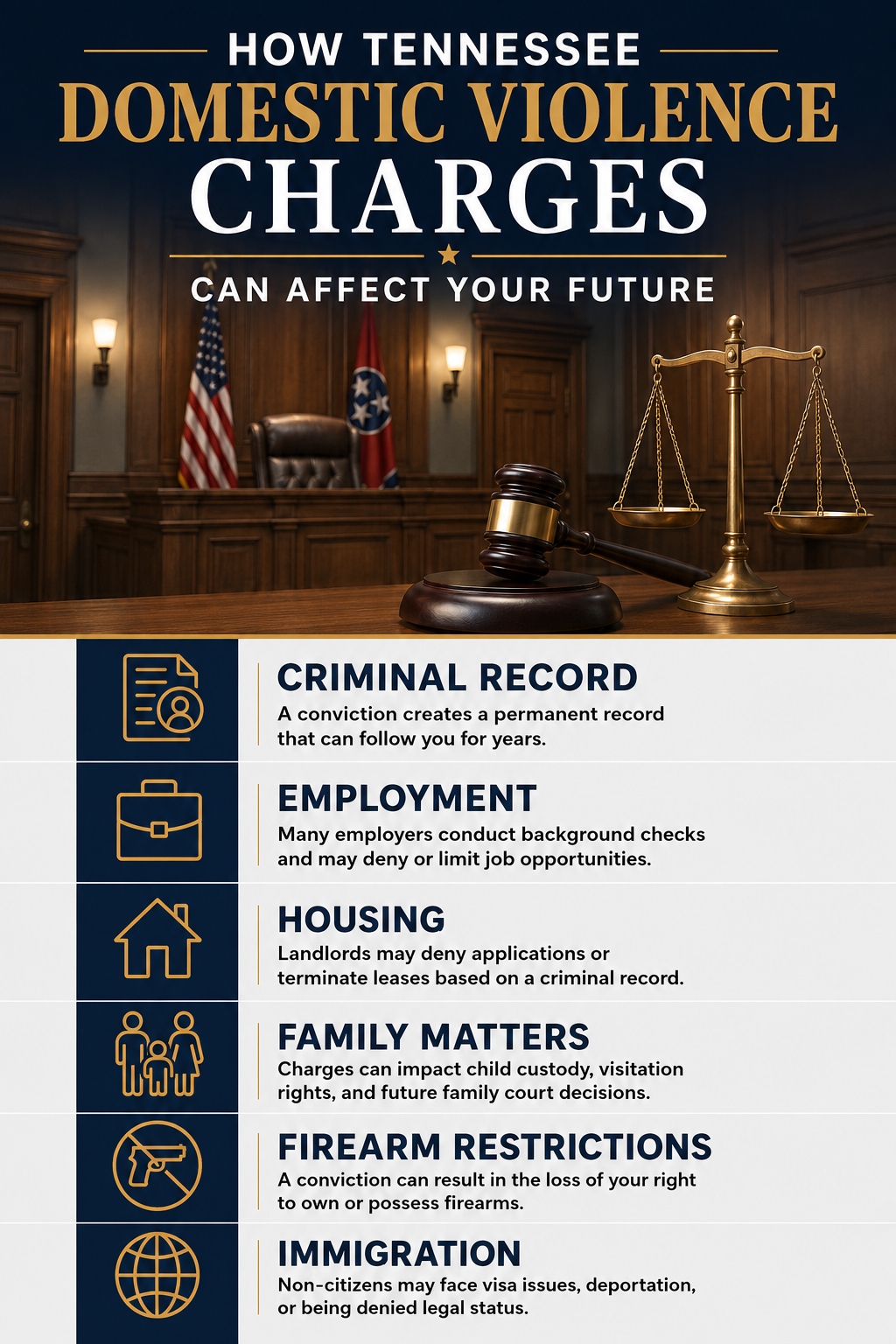
How Tennessee Domestic Violence Charges Can Affect Your Future
A domestic violence charge can affect more than your current court case. Depending on the outcome, it may influence your criminal record, employment, family matters, housing opportunities, and other important areas of your future. If a case is dismissed or otherwise resolved in a qualifying way, Tennessee law may allow certain criminal records to be expunged. Tennessee Courts provides official information about expungement eligibility and the process.
Why Early Legal Representation Matters
Domestic violence cases move quickly, and early mistakes can limit your options. An experienced Knoxville domestic violence defense attorney can:
- Communicate with prosecutors early
- Preserve favorable evidence
- Challenge weak or improper arrests
- Address bond and no-contact conditions
If you’re facing domestic violence charges in Knoxville, call The Watson Law Firm at 865-259-0948 to discuss your legal options.
Conclusion
Facing domestic violence charges can have serious consequences for your freedom, family, and future. You do not have to navigate the process alone. The Watson Law Firm provides focused criminal defense representation for clients facing domestic violence charges in Knoxville and throughout East Tennessee. Our attorneys personally handle each case and work to protect your rights and pursue the best possible outcome.
|
Facing domestic violence charges in Tennessee? Get trusted legal guidance from The Watson Law Firm! |
FAQ’s About Domestic Violence Charges in Tennessee
Q1. What happens at the first court hearing for a domestic violence charge in Tennessee?
The first hearing generally addresses the defendant’s case status, release conditions, and upcoming court proceedings. Depending on the circumstances, the court may also address bond and restrictions that apply while the case is pending.
Q2. Can a Domestic Violence Charge Be Removed From Your Record in Tennessee?
Sometimes. Whether a domestic violence charge can be removed depends on the offense, how the case ended, and your criminal history. A dismissed charge does not always qualify for removal. Tennessee has specific rules about which records can be expunged.
Q3. Should I speak with police after being accused of domestic violence?
Anything you say during an investigation can potentially become part of the case. If you are being investigated or have already been charged, it is generally wise to understand your legal rights and speak with a Tennessee criminal defense attorney before making detailed statements about the allegations.
Q4. What happens if someone violates a no-contact order in Tennessee?
Violating a court-ordered restriction can create additional legal problems separate from the original domestic violence allegation. Tennessee courts recognize penalties for violations of orders of protection, and the specific consequences depend on the type and terms of the order.
Q5. How long does a domestic violence case take in Tennessee?
There is no fixed timeline for every case. The length can depend on the charges, court schedule, evidence, motions, negotiations, and whether the case proceeds to trial. Some cases resolve relatively quickly, while others may take considerably longer.